As students in Athens prepare for a new school year, parents naturally focus on school supplies, new clothes, and sports gear. However, the most vital tool for classroom learning is clear, comfortable vision. Nearly 80 percent of what a child learns in school is presented visually. When a student struggles to focus on a page or see the board, academic performance and confidence can suffer. At Thomas Eye Center, our optometric team provides comprehensive pediatric eye exams that look far beyond standard eye charts to protect your child's sight and support their learning.
School Vision Screenings vs. Clinical Pediatric Eye Exams
A school vision screening is a basic check designed to catch major distance vision problems, whereas a clinical pediatric eye exam evaluates the entire visual system, including eye teaming, tracking, and overall ocular health.
Many parents assume that passing a school vision screening means their child has perfect eyesight. In reality, standard vision screenings at school usually only test distance visual acuity—how well a child sees letters on a chart from 20 feet away. While catching distance issues like nearsightedness is helpful, these basic checks miss many critical functional vision problems.
Our pediatric eye exams at Thomas Eye Center examine how your child's eyes work together as a team. Reading, writing, and computer work require precise visual coordination. A child can have 20/20 distance vision while still struggling with eye strain, fatigue, or double vision during reading. Our experienced eye care team in Athens, Georgia tests every aspect of your child's visual system to catch barriers to learning early.
Key Functional Vision Skills Needed for Reading and Classroom Focus
Students rely on complex functional vision skills, such as tracking across lines of text and switching focus between near and far objects, to read smoothly and stay focused in class.
Classroom learning demands continuous visual coordination and stamina. When one or more functional vision skills are underdeveloped, students must work twice as hard to process information. Here are the core visual skills our team evaluates during an exam:
-
Eye Tracking: The ability to move the eyes smoothly across a line of printed text or follow a moving object without losing place.
-
Eye Teaming: The ability of both eyes to work seamlessly together as a coordinated pair, preventing double vision and depth perception issues.
-
Focusing Flexibility: The ability to quickly and clearly shift focus between a desk notebook and the whiteboard at the front of the room.
-
Visual Perception: The brain's ability to interpret, recall, and organize visual information correctly, which is vital for spelling, math, and reading comprehension.
Recognizing Hidden Signs of Vision Difficulties in Children
Children rarely complain about vision problems because they assume everyone sees the world the way they do, making behavioral signs the primary way to identify visual strain.
Because children do not know what normal vision feels like, they seldom ask for help. Instead, visual frustration often shows up through physical habits or changes in academic performance. Parents and teachers in Athens can look for these common warning signs:
-
Covering or closing one eye while reading or watching television.
-
Rubbing eyes frequently during or after homework time.
-
Holding books or digital tablets unusually close to the face.
-
Losing their place while reading or using a finger to guide their eyes along text.
-
Complaining of frequent headaches or sore eyes by late afternoon.
-
Avoiding reading or schoolwork that requires close visual focus.
When a student comes to our practice struggling to keep their place on a page or maintain focus during homework, identifying these underlying visual roadblocks is often the key to unlocking their academic confidence and enjoyment in school.
Protecting Long-Term Visual Health and Myopia Control
Early clinical eye care allows optometrists to track nearsightedness progression and implement specialized treatments to preserve long-term eye health.
Beyond immediate classroom performance, annual pediatric eye exams play a critical role in long-term health. Childhood nearsightedness (myopia) is increasing rapidly among school-aged children due to increased screen time and less time outdoors. Left unmanaged, progressing myopia can lead to thicker prescriptions and higher risks of serious eye conditions later in life.
At Thomas Eye Center, our eye care professionals offer proactive myopia management strategies tailored to growing children. By monitoring eye shape and prescription changes during routine visits, we help protect your child's sight today and secure their ocular health for the future.
Frequently Asked Questions
How often should a child get a comprehensive eye exam?
Children should have their first eye exam as infants, another before starting school, and annual comprehensive exams throughout their school years.
Annual exams are recommended for school-aged children because their vision and eyes change rapidly as they grow. Regular visits ensure that any functional vision issues or prescription changes are caught before they impact school performance.
Why isn't a school vision screening enough for my child?
School vision screenings only test basic distance vision and miss many visual problems, including eye tracking, focusing agility, and binocular alignment.
A school screening is a pass/fail assessment designed to spot gross vision problems. It does not evaluate eye health, depth perception, or the functional vision skills required for reading and sustained screen work. A doctor-led exam at Thomas Eye Center provides a complete evaluation.
What should I expect during a pediatric eye exam at Thomas Eye Center?
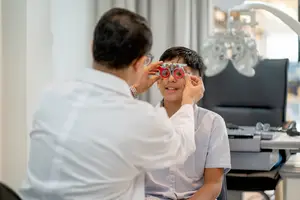
A pediatric eye exam is gentle, non-invasive, and includes tests for visual acuity, eye alignment, tracking ability, and internal eye health.
Our friendly optometric team creates a comfortable environment for children of all ages. We use engaging, age-appropriate technology to evaluate how well your child sees, how their eyes work together, and the overall health of their eyes, ensuring a positive experience for your family.
Can vision issues be mistaken for learning or attention disorders?
Yes, children with undetected visual tracking or focusing problems often show signs of restlessness, poor reading comprehension, and short attention spans that resemble attention disorders.
When reading causes physical strain or blurred text, a student may naturally fidget or avoid schoolwork. Treating the underlying visual dysfunction with proper glasses or guidance often resolves these behavioral difficulties and restores classroom focus.
Give your child the visual advantage they need for a successful school year. Schedule a pediatric eye exam with Thomas Eye Center today to ensure your student is ready to excel in the classroom.